Three cities, two onsen towns, a country measured in small rituals between. Ten to eighteen-night journeys, every one made to measure.
There is a precision to Japan that takes some unlearning — a tea ceremony measured in millimetres, a Shinkansen platform marked to the centimetre, a meal that arrives at the exact temperature it was meant to.
Our Japan journeys move between two registers — the high-frequency hum of Tokyo and Osaka, and the slower country pulse of Kanazawa, Hakone, the Kii Peninsula. You move by bullet train and on foot. You sleep in steel-and-glass towers one night and a hundred-year-old ryokan the next, with a futon laid while you bathe.
We pair every guest with private, English-speaking specialists in each region. They know which sushi counter takes walk-ins after nine, which mountain temple still permits overnight stays, which onsen has the better view at sunrise.

The full sweep: Tokyo, Hakone, Osaka, Kyoto, Kanazawa. Cooking course, sake brewery, a Hiroshima & Miyajima day trip, a ryokan night with a private onsen overlooking Fuji.
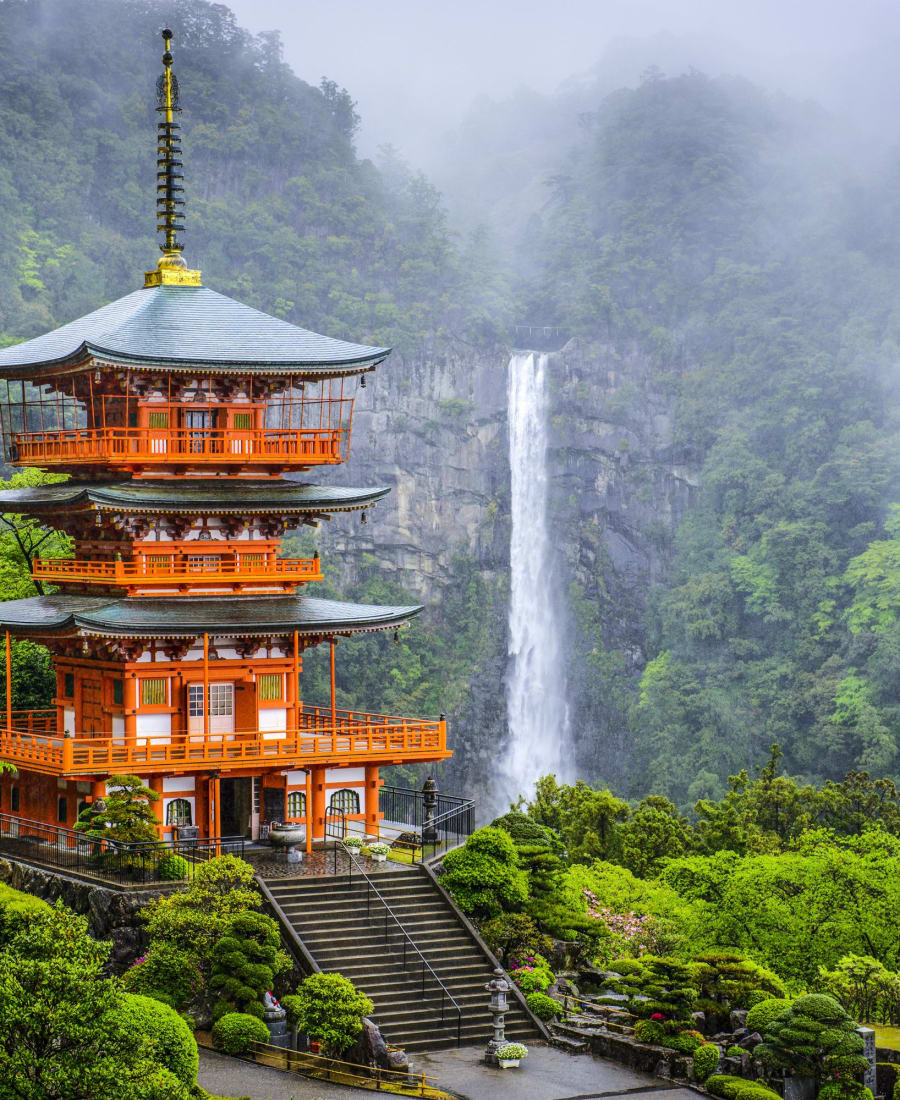
A thousand-year-old walking path between mountain shrines on the Kii Peninsula. Family-run minshuku each night, packs forwarded ahead, hand-drawn route notes from our Wakayama specialist.
Tsukiji-trained breakfast in Tokyo, a kaiseki tasting in Kyoto with a sixteenth-generation chef, sake brewery in Niigata, a soba master class outside Nagano.
Across Honshu in winter: snow monkeys at Jigokudani, ryokan in the Japanese Alps, a black-roof village in Shirakawa-go, Kanazawa kitchens warm with miso and crab.
Naoshima, Teshima, Inujima. Tadao Ando's concrete cathedrals, James Turrell's light room, a private dinner at Benesse House. Hopping the ferries with a Tokyo-based curator.
A blank page. Tell us what you love (gardens, ceramics, baseball, jazz kissas, a single quiet temple) and we'll build the rest. Most of our Japan work starts here.
The inner market is closed to the public, but the outer arcade hums before dawn. Our Tokyo guide knows the egg-roll counter that has run for four generations.
Tatami floors, futon laid while you bathe, multi-course kaiseki served in your room. Hakone's Setsugetsuka, with hot-spring water from the volcano below.
Ten thousand vermillion gates climbing the mountainside behind Kyoto. Go at five. The crowds thin, the lanterns light, the foxes look braver.
One of Japan's three great gardens, in Kanazawa. Plum blossom in February, irises in June, crimson in November, snow ropes in January.
The floating torii of Itsukushima, two ferries from Hiroshima. Stay overnight on the island and watch the deer wake up before the day-trippers arrive.
An entire island given over to contemporary art on the Inland Sea. Tadao Ando concrete, Yayoi Kusama pumpkins, James Turrell rooms.
Jigokudani in Nagano, January–March. Japanese macaques bathing in steam, an hour's walk through cedar snow to reach them. The cold is worth it.
Tokyo's mid-century listening cafés — turntables, valve amps, no conversation. Try DUG in Shinjuku or Meikyoku Kissa Lion in Shibuya. Order coffee. Stay.
Most first-time itineraries thread Tokyo–Hakone–Kyoto–Osaka. Add a night in Kanazawa for craft and seafood. Add three for the Kumano Kodo pilgrimage walk in Wakayama. Add a week for Setouchi's art islands.
Three meaningful things a day is plenty. Tea ceremony in a Kyoto temple. A sushi counter where you sit for two hours. A walk between mountain shrines with no phone. Resist the cathedral checklist.
Sushi in Tokyo, kaiseki in Kyoto, okonomiyaki in Osaka, kaisendon in Kanazawa, miso ramen in Hokkaido. Convenience stores are excellent. So is the breakfast set at any train station.
Cherry blossom (late March–early April) is exquisite and crowded. Autumn foliage (mid-November) is the quietest of the four classic seasons. Winter for snow monkeys, clear days, empty temples. Summer for festivals — and heat.
No two of our Japan journeys have ever been identical. Send a few notes about how you travel, and a specialist will be in touch within one working day.
